
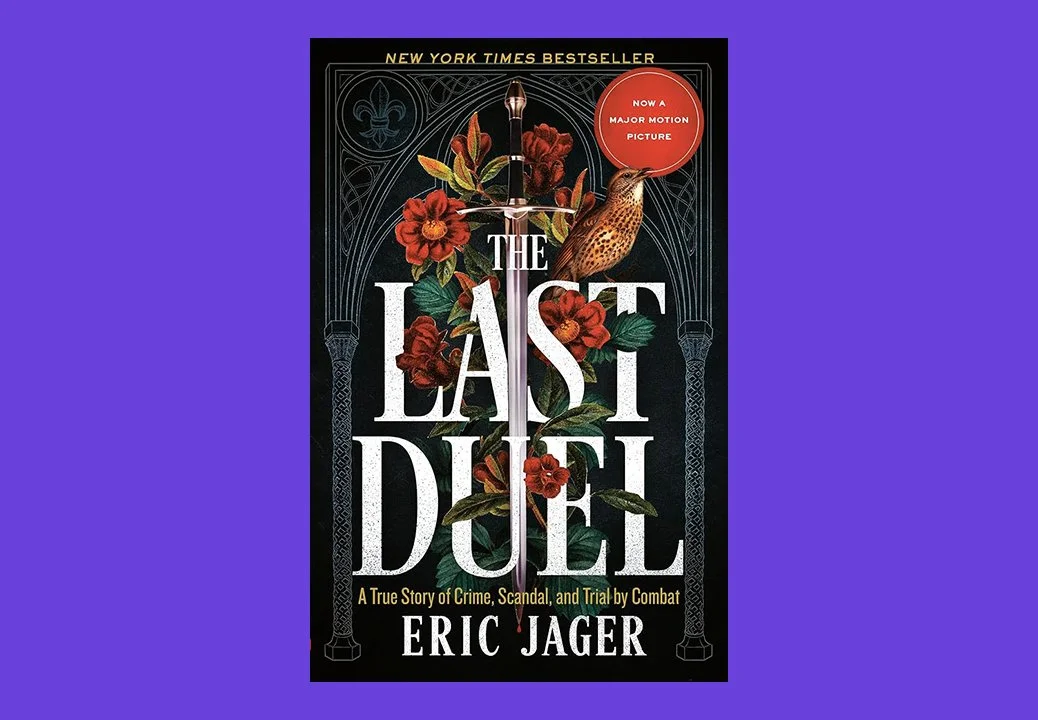
I must admit: I have a hard time staying away from historical nonfiction.
Even when I go to a bookstore intending to buy fiction, I inevitably find myself strolling the history shelves, just to see if anything catches my eye.
And so it was the slender spine of The Last Duel that proved too tempting to pass up. Amidst the usual historical tomes, this short work seemed to promise the exact kind of quick excursion into medieval history that would be perfect for my poolside summer weekends.
One of the blurbs claimed that, had readers not known it was true, they might have mistaken it for Game of Thrones fan fiction. In retrospect, I was clearly looking for some mainstream fiction to inject straight into my veins.
Ironically, that may have primed me for the same tension I ultimately found in the book itself: a work that never seems to fully decide whether it wants to be a serious, credible account of history or a piece of historical entertainment.
Second confession: I didn’t read the synopsis.
The "Soon to be a Major Motion Picture" medallion was enough to seal the deal because: A) I love going into books blind, and B) I'm always curious to see which books Hollywood decides are worth adapting.
So, without going any further, the central event of this book is a (trigger warning) historical account of rape. My opening isn't meant to trivialize that, only to explain the mindset in which I happened to pick up the book.
The Last Duel recounts the true story of the final judicial duel fought in medieval France between the knight Jean de Carrouges and the squire Jacques Le Gris. After years of disputes over land, inheritance, status, and political favor leave Carrouges increasingly isolated from his lord, tragedy strikes when Le Gris rapes Marguerite.
I’ll take a moment to pause here.
I’m glad the author sheds light, albeit briefly, on the horrific consequences women like Marguerite faced after publicly accusing powerful men of rape. In most cases, to no one’s surprise, it sounds like the accused were inevitably released of charges without any resemblance of a fair trial, and the women themselves could face execution for 'false accusation.'
When Marguerite’s accusation is dismissed by lord Count Pierre d'Alençon, Carrouges appeals directly to the King of France, seeking permission for a trial by combat. By this point in the fourteenth century, judicial duels had largely fallen out of favor, making the king's approval of the duel a surprising anomaly. The widespread belief that God would reveal innocence or guilt through combat lends the story an undeniable dramatic weight.
And yet…
Here’s where the book lost me.
It's clear that Eric Jager conducted extensive research into this episode of medieval history, but it felt as if every fascinating detail he knew about the period managed to find its way onto the page. The historical material didn't weave into the overarching narrative as seamlessly as I'd hoped. While some context is certainly necessary, much of it felt disjointed and disruptive, repeatedly interrupting the central story.
History is full of wonderful rabbit holes. Normally, I'm more than happy to disappear down them. Here, though, I kept waiting for the historical digressions to click into place, to illuminate the central story in some unexpected way. Instead, they often felt like separate conversations happening alongside it. Rather than enriching the story, they often diluted it…
I was also disappointed by the presentation of the scholarship itself. Although the book includes a bibliography, it doesn't provide citations or footnotes throughout the text, something I feel quite strongly about when it comes to historical nonfiction. I like being able to trace individual claims back to their original sources. The research is clearly there. It’s just buried. Given the book's short length, I don't think footnotes would have been intrusive. If anything, I think they would have strengthened the book's credibility.
So yes, The Last Duel ultimately feels caught between two identities. On one hand, Jager is clearly interested in writing a serious work of history. On the other, it often feels as though he's trying to package that history as an accessible historical thriller full of court intrigue, betrayal, and dueling spectacle. Rather than fully embracing either approach, it oscillates between the two.
The result is a book that constantly pauses its own momentum. The historical account is enough on its own.
It didn’t need quite so much surrounding it.